
Blog
How Much Car Lift Capacity Do You Need?

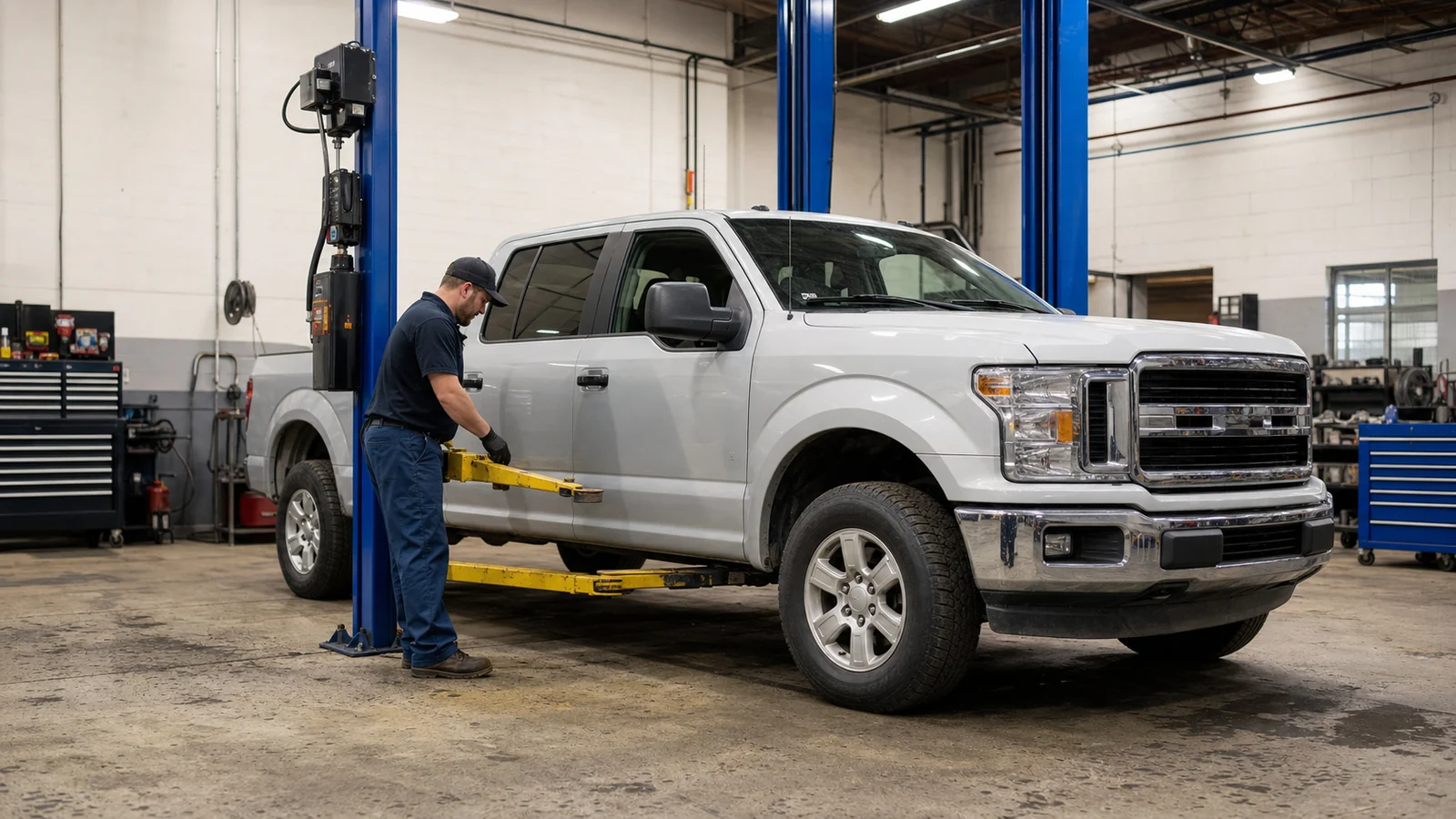
Rated capacity is a limit, not a vehicle-fit guarantee. A lift also has to reach the approved lifting points, accommodate the vehicle’s weight distribution, fit its wheelbase and track, and operate within every per-arm, axle, runway, adapter, and configuration limit published by the manufacturer.
Begin with the vehicle in its real operating condition
Do not base the decision only on a brochure’s curb weight. Consider passengers, tools, service bodies, cargo, aftermarket equipment, auxiliary tanks, batteries, and anything normally carried when the vehicle enters the bay. For commercial vehicles, obtain reliable weight information for the actual configuration.
Capacity questions to answer
- What is the heaviest vehicle? Record its verified operating weight, not an estimate based on a smaller trim.
- How is the weight distributed? Front/rear and side-to-side loading affect how the vehicle is supported.
- Where are the approved lifting points? Confirm that the model’s arms, pads, and adapters can engage them.
- Does the vehicle geometry fit? Check wheelbase, track width, ground clearance, tire width, and body overhang.
- What work will be performed? A service lift, alignment rack, parking lift, and mobile-column system solve different problems.
Understand the limits behind the headline number
A published total capacity can coexist with additional limits for individual arms, columns, axles, runways, rolling jacks, adapters, or wheel-contact points. Accessories also have their own ratings. The usable system capacity is governed by the lowest applicable limit in the exact setup.
Never assume that adding more adapters increases capacity. Adapters solve reach or contact-height problems only when approved for the lift and vehicle application.
Allow for tomorrow’s vehicle mix
Shops increasingly encounter heavier pickups, vans, commercial bodies, and battery-electric vehicles. Reasonable future planning can prevent an early replacement, but buying far beyond the real application can create unnecessary cost, space, power, and installation demands.
A useful shortlist covers the known vehicle mix with documented compatibility and a practical margin, while still fitting the bay and workflow.
Red flags during comparison
- A seller confirms fit using capacity alone.
- The actual installation manual is unavailable.
- Per-arm, axle, runway, or adapter limits cannot be found.
- The vehicle’s lifting points fall outside the published reach range.
- Required accessories are not approved for the selected model.
- The buyer is encouraged to “make it work” by changing contact locations.
Capacity with context
Compare the full specification—not only pounds
Use the filters and product data to build a shortlist, then confirm vehicle geometry and the selected configuration.