
Blog
Four-Post Car Lifts for Storage and Service


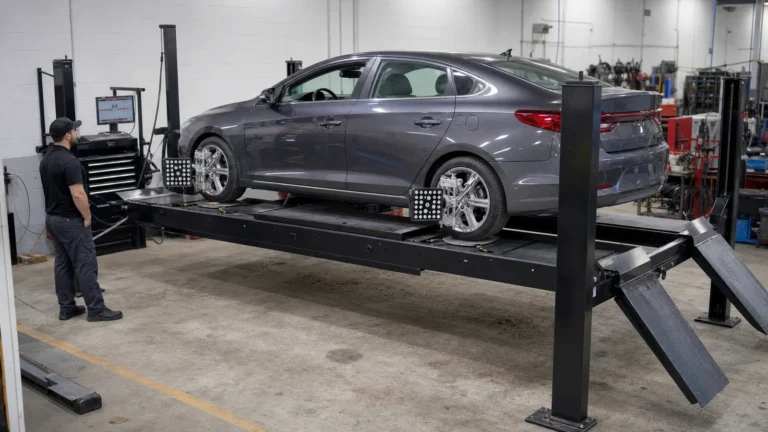
Four-post lifts are popular because the vehicle drives onto runways and remains supported at the tires. That makes them useful for storage, inspection, fluid service, exhaust work, and—on properly equipped racks—alignment. The tradeoff is that wheel-free work normally needs additional equipment.
Storage and service models are not automatically identical
A parking-focused lift may prioritize compact dimensions, approach ramps, locks, drip trays, and residential power. A service rack may prioritize capacity, runway length, access, jacking options, and higher utilization. An alignment model adds features such as turntable locations and rear slip-plate areas.
Choose the application first. Do not assume that any four-post model can be converted into any other use by adding accessories.
Vehicle and runway fit
- Wheelbase range: the tires must remain correctly supported on the runways.
- Track width: tires must fit the allowable runway positions and widths.
- Tire width: confirm full support, especially for wide or specialty tires.
- Approach angle: low vehicles may need compatible extended ramps or other approved solutions.
- Overall vehicle length: account for overhang, ramps, and garage-door movement.
Planning stacked parking height
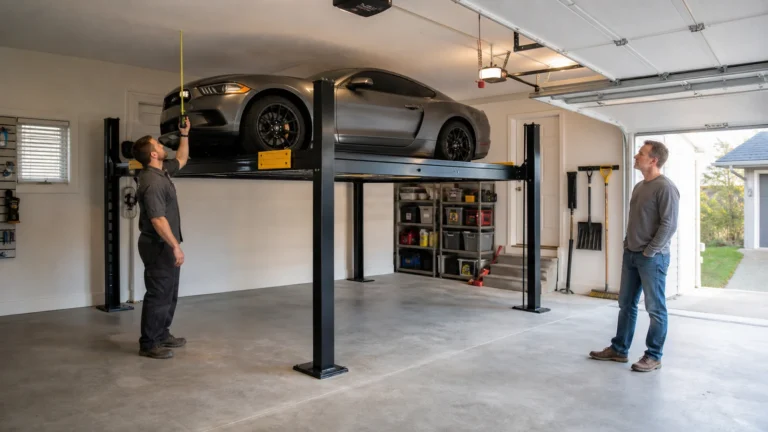
Usable height depends on both vehicles, the lift’s runway and lock geometry, the selected parking position, and every overhead obstruction. Measure the lower vehicle at its tallest fixed point and the upper vehicle at its tallest point. Add the structural dimensions and clearances specified by the manufacturer.
Door tracks and openers are frequent conflicts. A high-lift door conversion may help some garages, but it should be planned with qualified garage-door and lift professionals before installation.
Wheel-free service
Rolling bridge jacks can raise an axle or end of the vehicle above the runways when the lift and jack combination is approved. Compare jack capacity, travel, pad reach, air requirements, rail compatibility, and storage position. The bridge jack’s own rating remains a separate limit.
Useful accessories
- Drip trays for parking use
- Rolling bridge jacks for approved wheel-free work
- Jack trays for appropriate service tools
- Caster kits on models designed for relocation when unloaded and lowered
- Approach ramps or extensions approved for the model
- Wheel stops, chocks, and manufacturer-required safety components
Questions to settle before ordering
- Is the primary goal parking, service, alignment, or a documented combination?
- Do both the longest and widest vehicles fit the runways?
- Is there enough straight approach space?
- Can the building accommodate every working and parking position?
- Which accessories are approved for this exact model and capacity?
Drive-on solutions
Match the runways to your vehicles
Compare four-post dimensions, capacities, configurations, and accessories before deciding between storage and service use.